Verida
Designing an AI-powered personal finance app from scratch. A mobile solution that simplifies personal finances through personalized insights, smart notifications, and a conversational chat.
Finance
B2C Mobile App
My Role
Product & UX/UI Designer
Duration
Oct 2025
Platform
Mobile App (iOS & Android)

Overview
I worked on this AI-driven finance app as a personal concept design to explore how users can effortlessly track spending, manage budgets, and achieve savings goals. I designed personalized financial insights delivered through a conversational chat interface, smart notifications, and engaging progress trackers while utilizing multiple AI Coding tools.
My focus was on building a clean, modern mobile UI optimized for usability and accessibility, while integrating complex features such as secure multi-account aggregation and machine learning–based transaction categorization. This project demonstrates my ability to translate sophisticated AI and financial data into a simple, user-centered product.
My Role
As the sole UX/UI and product designer, I was responsible for the full design lifecycle, from research and concept development through to high-fidelity visual design and prototyping. I focused on creating an intuitive user experience that integrates complex AI-driven features while maintaining clarity and ease of use across mobile devices.
The Objective
To design a personal finance app concept that leverages AI to simplify money management for everyday users. The goal was to enable effortless tracking of spending and budgets, provide meaningful, personalized insights, and motivate users to achieve their financial goals, all within a secure and accessible mobile environment.
Design Process
I used AI prototyping tools such as Claude, and v0 extensively during the design process to accelerate ideation and UI exploration while maintaining full control over product direction. The workflow included:
Defining the core vision of the app, including what it should be and what it should not be.
Creating a detailed Information Architecture and multiple user flows based on target users.
Using AI to rapidly prototype, iterate on layouts, and explore interaction variations.
Refining flows continuously while working with AI-generated concepts.
Designing example UI mockups to establish a clear visual direction.
This approach combined strategic product thinking with AI-assisted execution to enable faster iteration without compromising clarity, coherence, or design quality.
Solution
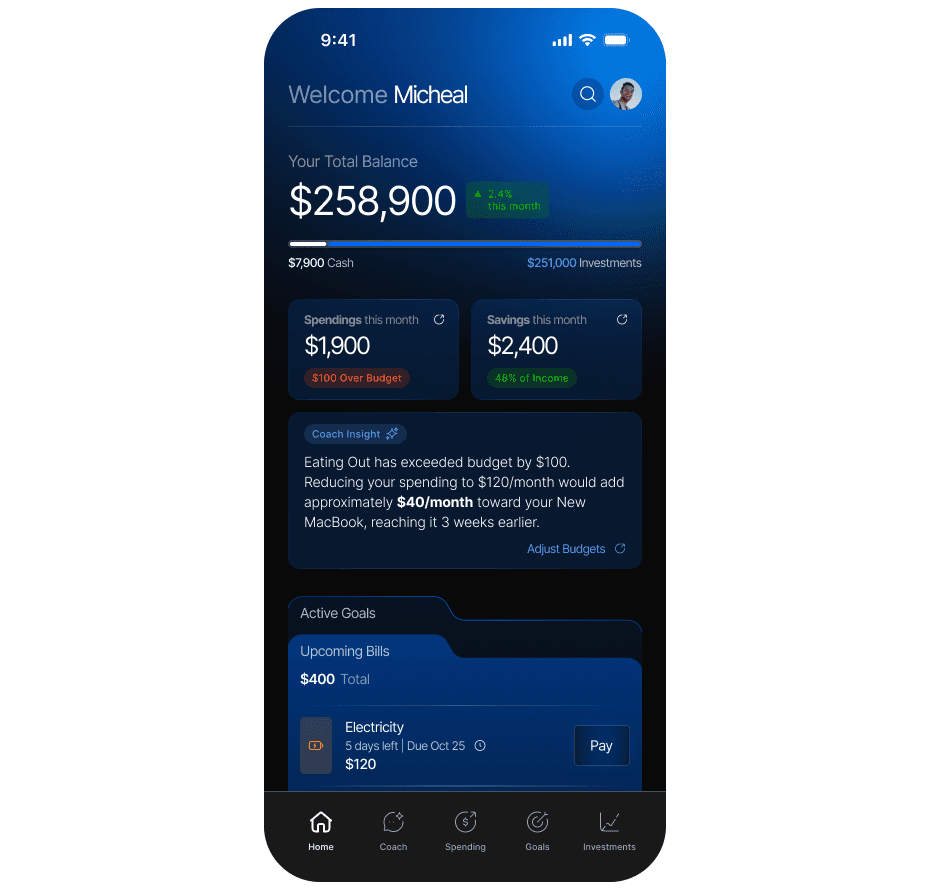
Personalized Financial Dashboard
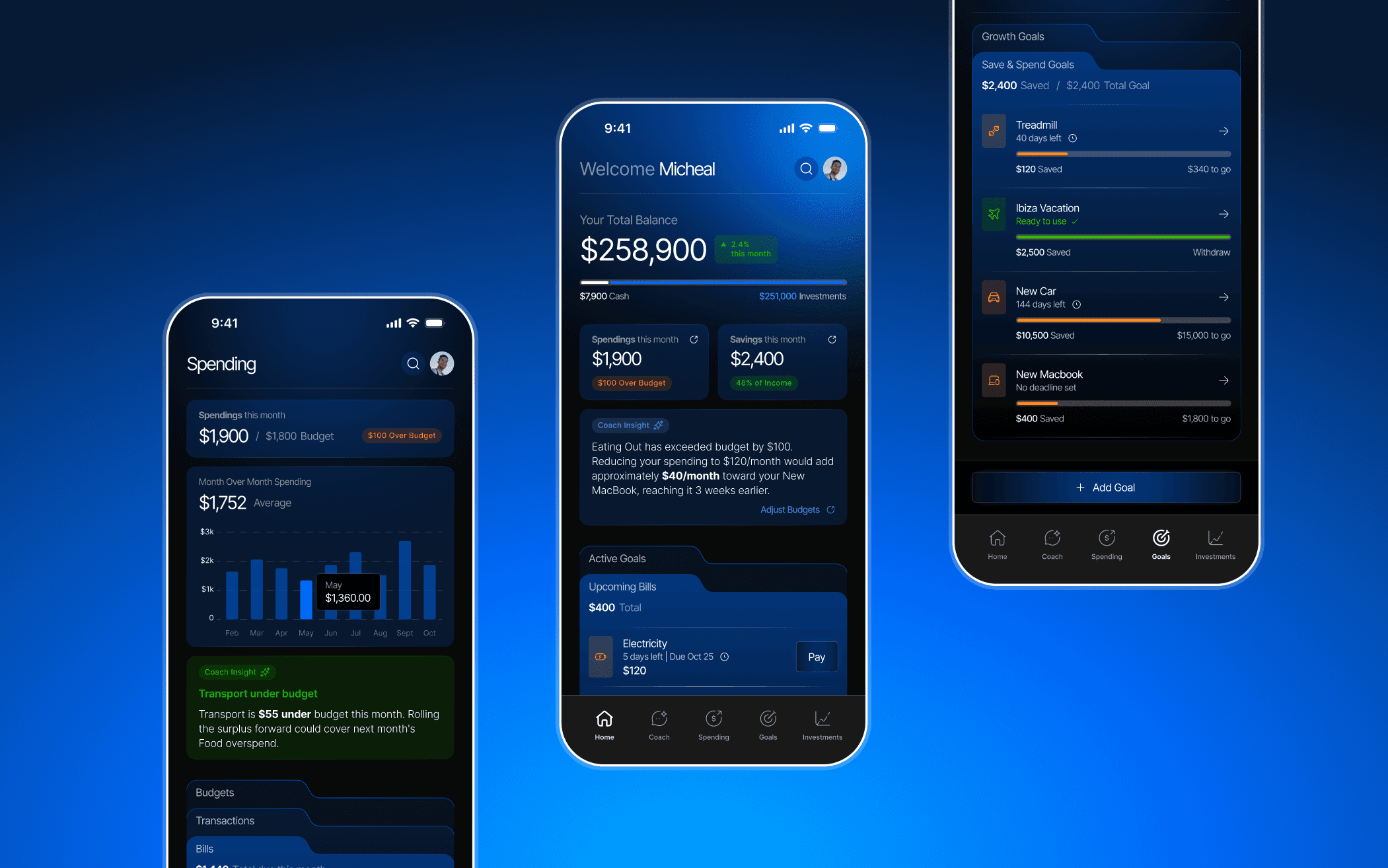
The dashboard functions as a centralized financial command center, designed to surface financial health at a glance.
Rather than emphasizing spending alone, the primary comparison highlights total saved versus total spent within the current month. This reframes the experience from reactive expense tracking to proactive financial awareness.
Core components include:
Monthly saved vs. spent comparison
Active goal contribution progress
Upcoming bills with projected impact
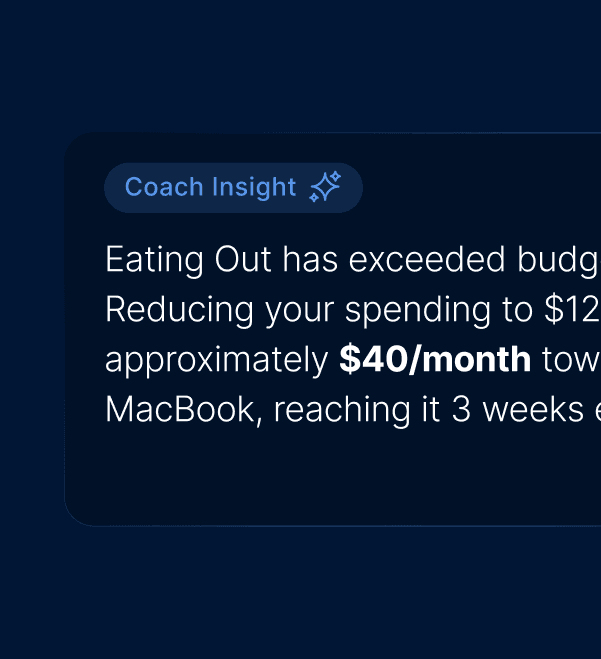
Contextual AI insights based on current financial behavior
AI insights are embedded directly within the dashboard to surface relevant trends, such as changes in savings rate, unusual spending patterns, or shifts in goal progress. This ensures users understand not only what is happening, but why.
The dashboard follows progressive disclosure principles, presenting high-level indicators first while allowing deeper exploration when needed. The goal is clarity, balance, and reduced cognitive load.
AI-Powered Financial Intelligence
Financial intelligence is integrated throughout the product rather than isolated in a single section.
Contextual suggestions appear within:
The dashboard
Budgeting screens
Goal progress views
Investment insights
These embedded recommendations support real-time decision-making without interrupting the user flow.
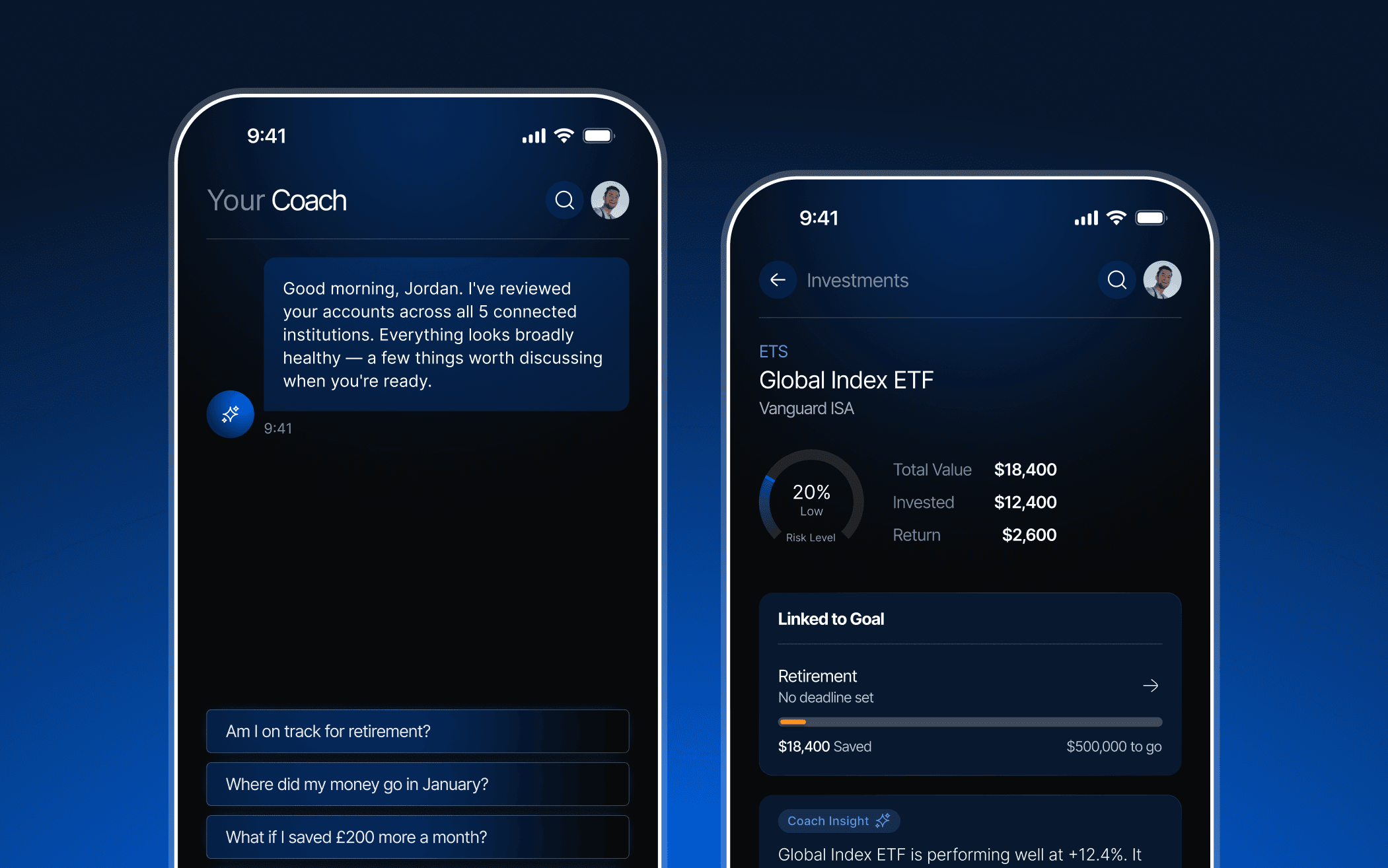
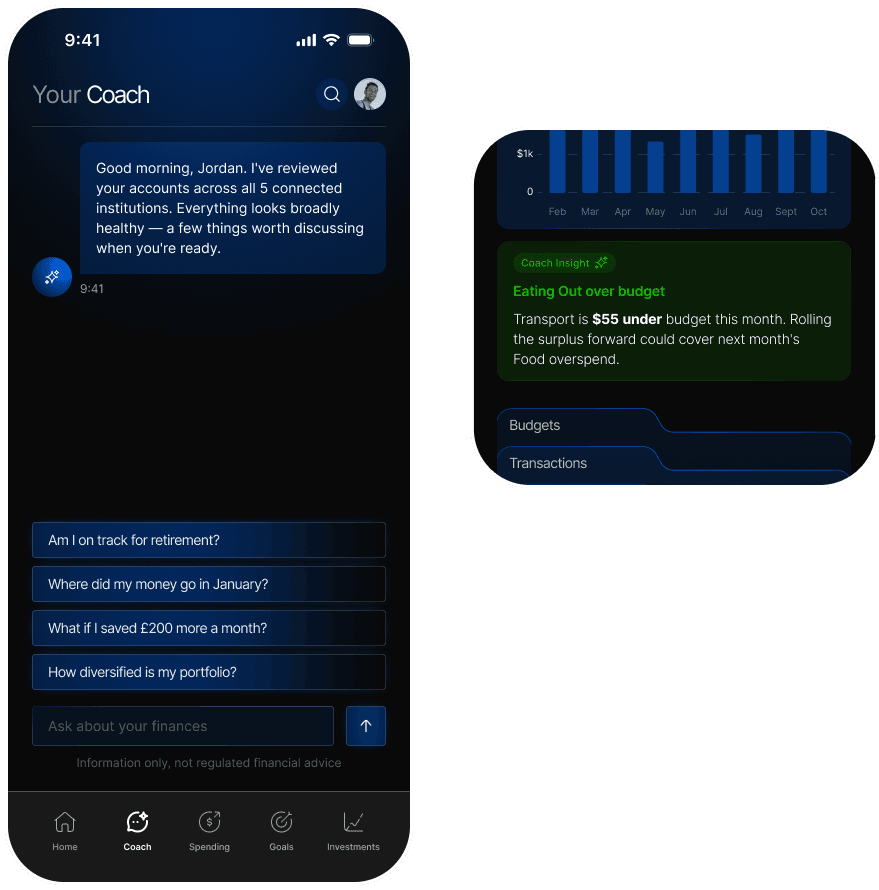
In addition to contextual insights, the platform includes a dedicated AI chatbot. The chatbot enables users to:
Ask natural language questions about spending, savings, or investments
Request detailed breakdowns
Simulate financial scenarios
Clarify financial concepts
This dual approach combines proactive system-generated guidance with on-demand conversational support, ensuring intelligence is both accessible and flexible.
Smart Budgeting & Expense Management
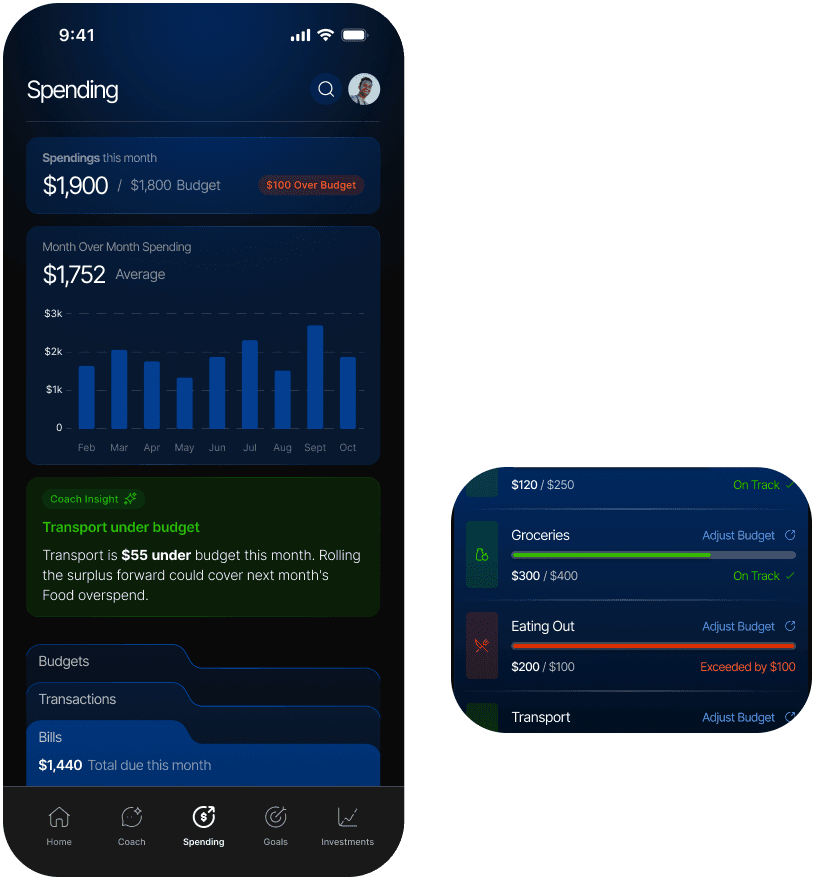
Expense tracking is automated using machine learning-based categorization, minimizing manual effort while preserving transparency.
The budgeting system communicates status through clear states:
On track
Approaching limit
Exceeded
Visual feedback is designed to remain calm and informative. Users can quickly reclassify transactions or adjust limits, maintaining control without friction.
Rather than focusing solely on restrictions, the system emphasizes understanding trade-offs between spending behavior and goal progression.
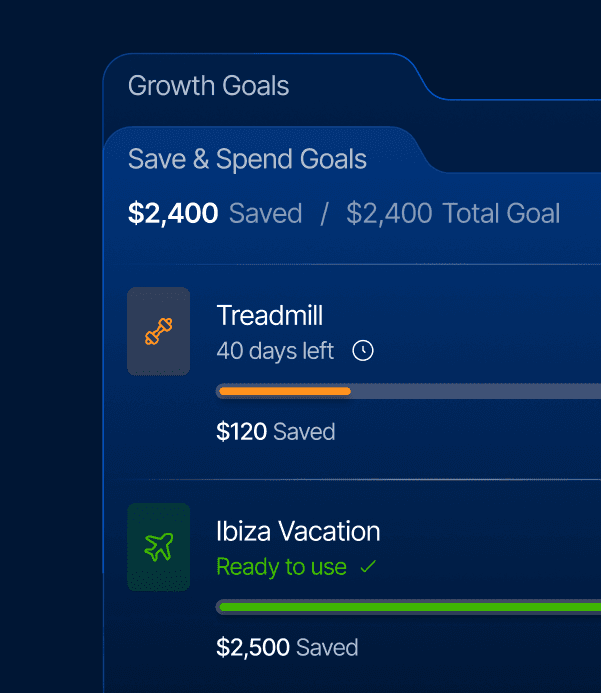
Goal Architecture: Spend Goals & Save Goals
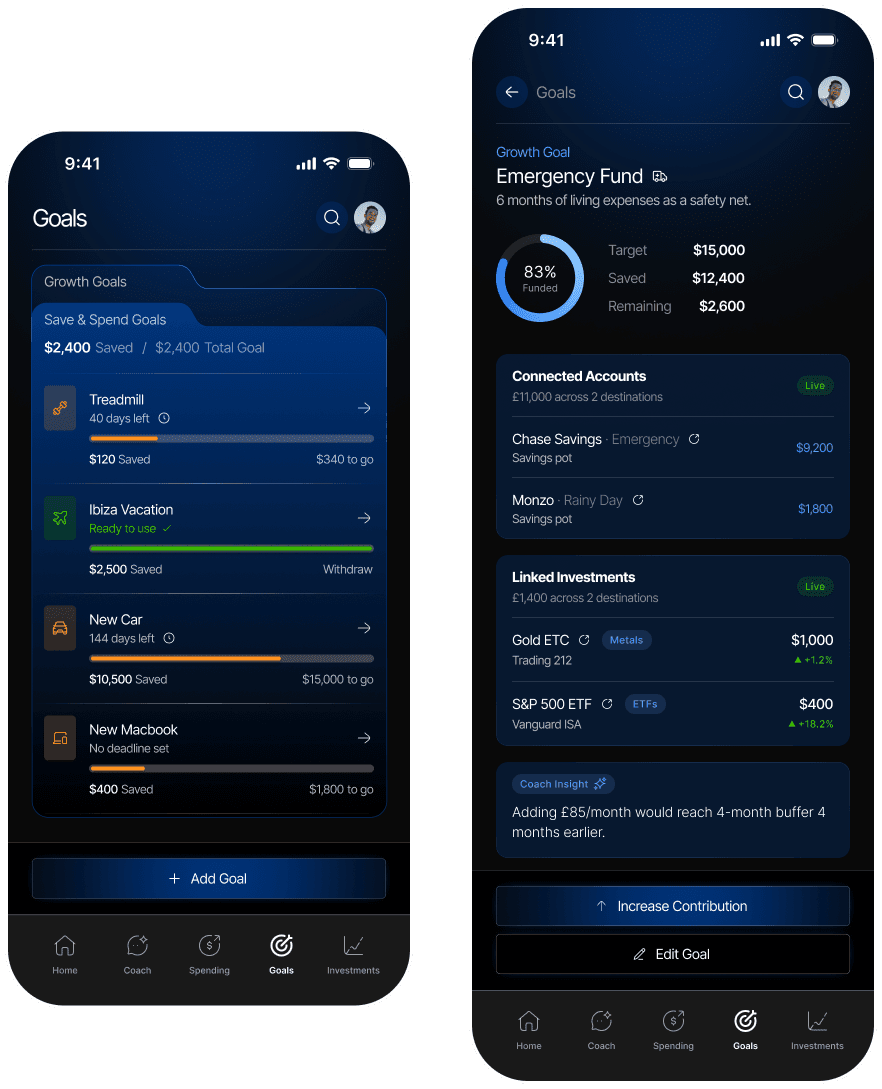
Goals are structured around behavioral intent rather than arbitrary timelines.
Spend Goals
Designed for intentional purchases such as technology, travel, or planned upgrades.
Features include:
Target amount and flexible deadline
Suggested monthly contribution
Dynamic completion projections
Contribution simulation tools
Spend goals enable users to plan purchases responsibly without disrupting overall financial stability.
Save Goals
Designed to build financial resilience and long-term stability, such as emergency funds or income buffers.
Features include:
Recommended target ranges based on spending behavior
Risk-aware contribution suggestions
Visibility into how savings protect against unexpected events
Save goals are integrated directly with budgeting and income consistency insights, reinforcing stability over consumption.
In addition, save goals are connected to the investment module. This integration allows users to understand how short-term liquidity (savings) and long-term assets (investments) function together within a unified financial strategy. The system provides visibility into maintaining adequate reserves while supporting sustainable investment growth and balanced risk exposure.
This alignment ensures that financial security and wealth building operate cohesively rather than independently.
Investment Portfolio & Wealth Tracking
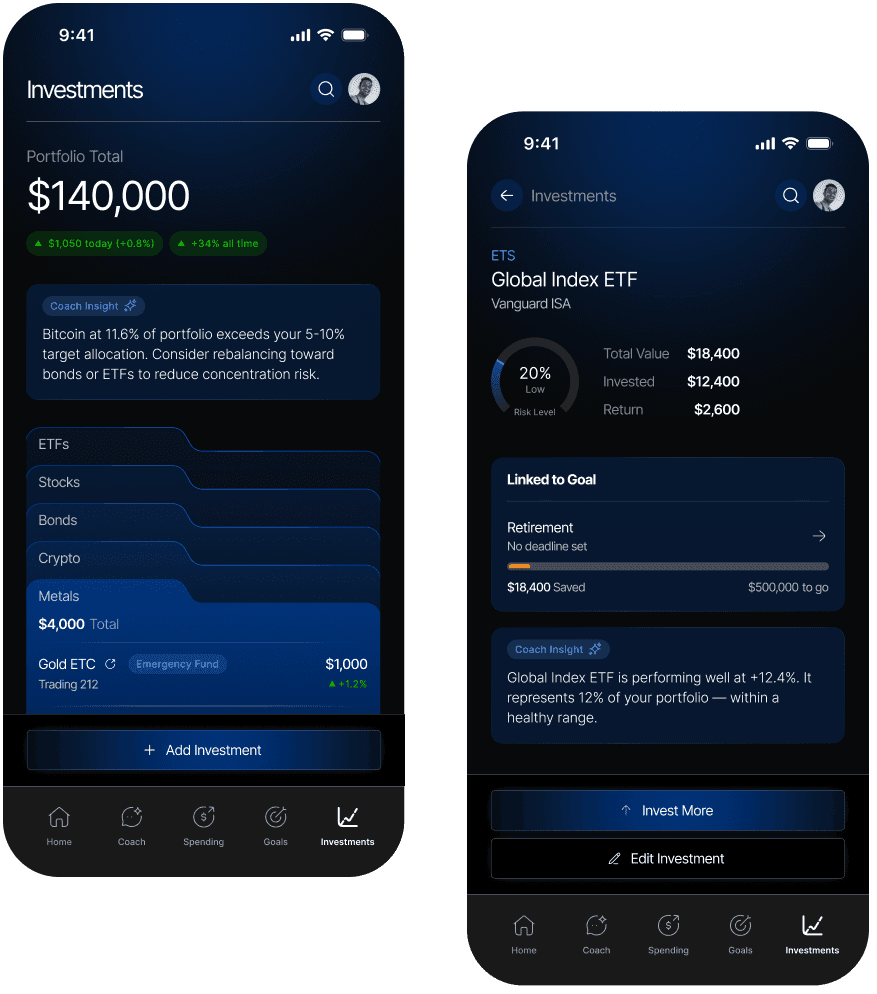
The investment module extends the product into long-term wealth management.
Users can view:
Total portfolio value and performance trends
Historical growth over time
Asset allocation breakdown
Risk exposure indicators
The interface prioritizes long-term perspective over short-term volatility. Investment insights are designed to support understanding, diversification awareness, and goal alignment.
AI-generated insights further connect investment performance to overall financial objectives, helping users evaluate how their portfolio contributes to long-term plans.
Secure Multi-Account Aggregation
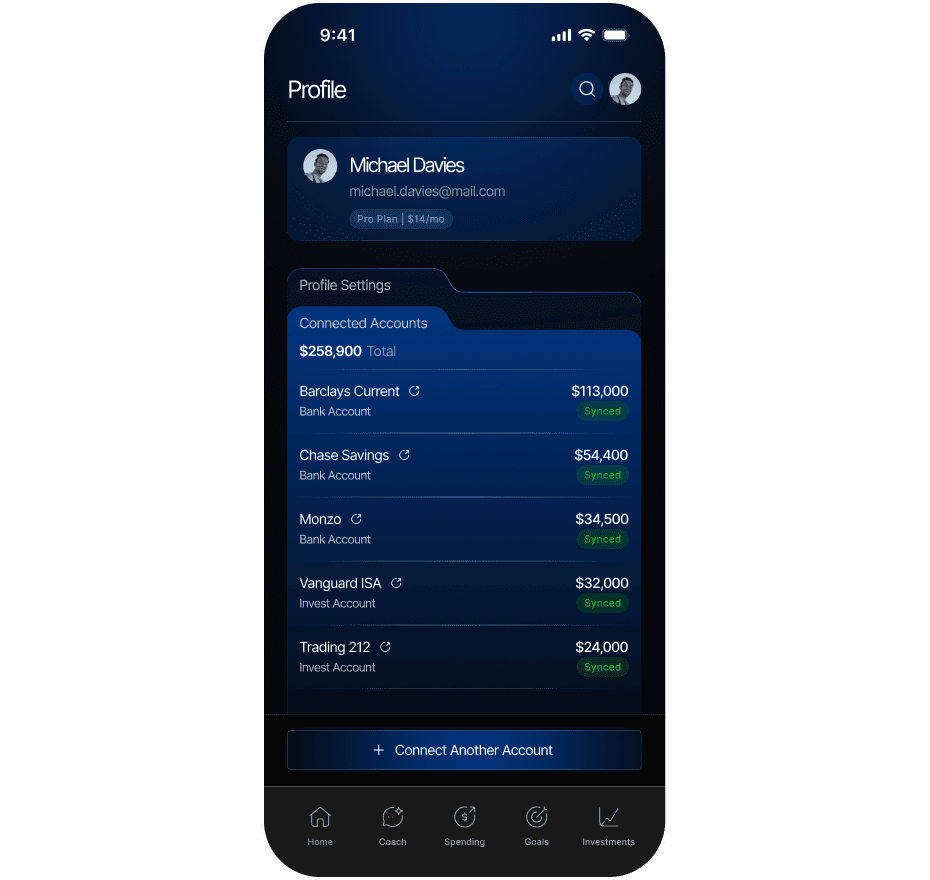
The platform securely connects bank accounts, credit accounts, and investment brokerages into a unified interface.
Each connection flow emphasizes:
Transparency around permissions
Clear authentication steps
Data encryption
Biometric security
Security is treated as a foundational design principle, communicated clearly without introducing unnecessary anxiety.
By consolidating fragmented financial data into one experience, the product increases clarity, control, and confidence.